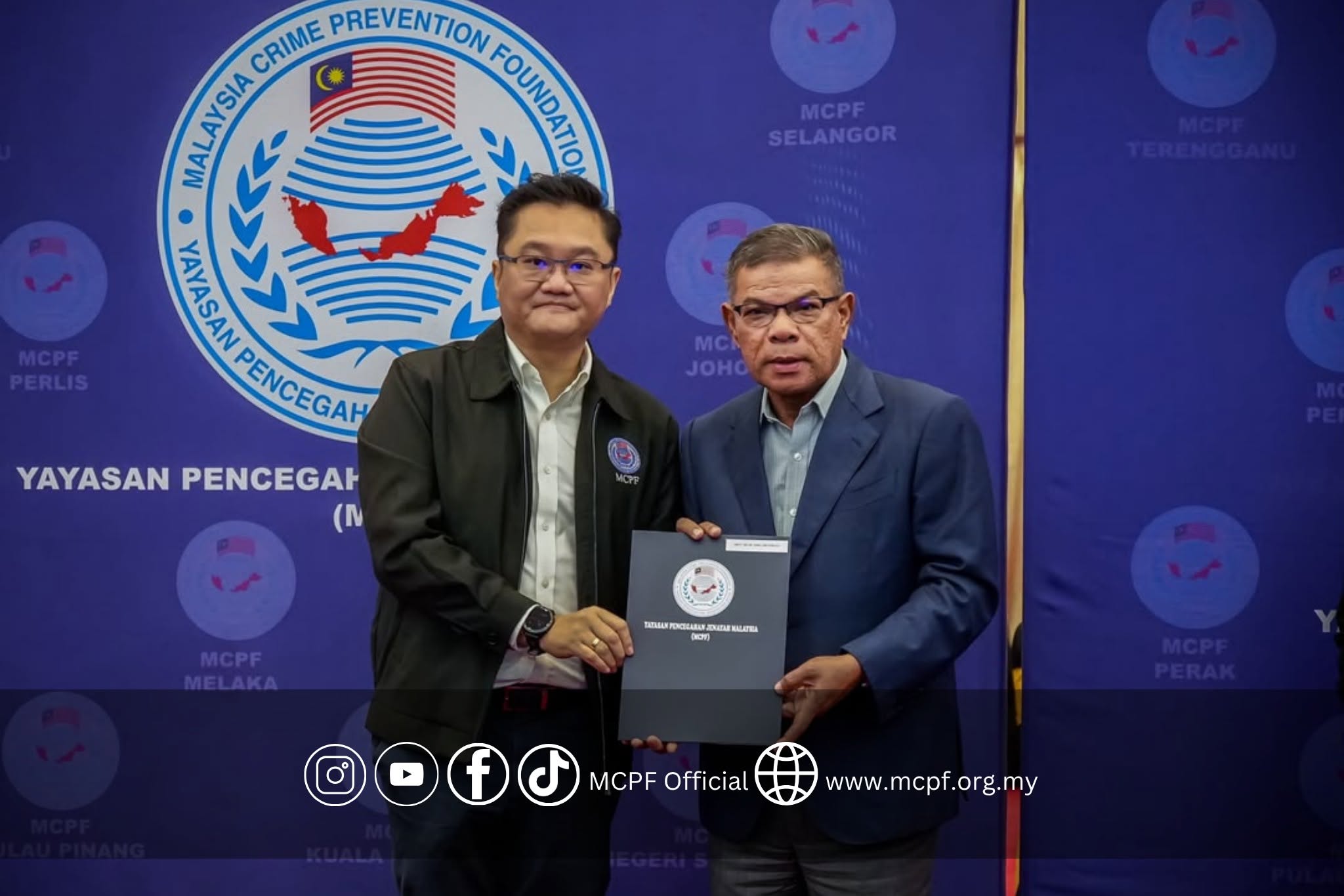
KUALA LUMPUR: The Malaysian Crime Prevention Foundation (MCPF) will continue to work closely with the Home Ministry, the Royal Malaysia Police and relevant enforcement agencies to strengthen public education and awareness on scam prevention, with greater emphasis on bringing anti-scam initiatives directly into local communities.
The direction was highlighted during MCPF’s first Executive Committee Meeting held on October 14 at the University of Malaya Alumni Association (PAUM) clubhouse.
The meeting was chaired by MCPF Chairman and Home Minister Datuk Seri Saifuddin Nasution Ismail, and attended by newly appointed executive committee members as well as ex-officio members.
The meeting also featured briefings by the Royal Malaysia Police’s Crime Prevention and Community Safety Department (JPJKK) and the National Scam Response Centre (NSRC), providing committee members with a deeper understanding of current scam trends, emerging crime-prevention challenges and existing response mechanisms.
The committee also discussed MCPF’s overall work plan for the 2026-2029 term, announced appointments to key positions, standing committee chairmanships and state liaison committee chairmanships, as well as reviewed the foundation’s current financial position.
Among the appointments, **Datuk Seri Dr King Lim Chin Fui** was appointed **Senior Vice-Chairman of MCPF** for the 2026-2029 term.
Other appointments include Datuk Muhammad Fuad Talib and Datuk Seri Dr Thaiveegan A/L Arumugam as Vice-Chairmen, while Datuk Seri Dr Erwan Dato’ Haji Mohd Tahir was appointed Treasurer.
King Lim expressed his appreciation for the confidence placed in him and said he would work closely with the chairman, the Executive Committee and state-level teams to further strengthen crime-prevention efforts, with anti-scam education identified as one of the key priorities.
He said closer collaboration would be pursued with the police, government agencies, community organisations, schools, business associations and companies to ensure scam-prevention information reaches a wider segment of society.
“As scam tactics continue to evolve, ranging from phone scams and fraudulent investment schemes to impersonation of enforcement officers and scams carried out through social media and messaging applications, prevention efforts can no longer be limited to warnings issued only after cases occur.
“Anti-scam awareness must become part of everyday life. Every extra step of verification before making a financial transfer adds another layer of protection. Whenever anyone is pressured to transfer money or asked to disclose banking information, passwords or verification codes, they should stop first and independently verify the request through the relevant organisation’s official channels.”
King Lim said scam-prevention information must be communicated in clear, simple and easily understandable language, supported by practical case studies so that people of all age groups can quickly recognise suspicious calls, messages, links and transaction requests.
He said particular attention should be given to senior citizens, students, homemakers and those who may be less familiar with digital platforms, as they require scam-prevention information that is practical and applicable to everyday situations.
“Anti-scam information must not be something only experts can understand. Ordinary members of the public must be able to understand it, remember it and put it into practice.
“Most importantly, when something suspicious happens, they must know when to stop, who to verify with and where to seek immediate assistance.”
He also encouraged the public to remind family members, friends and colleagues to adopt a habit of “discuss first, verify first” whenever they encounter suspicious situations.
“Very often, scammers depend on fear, panic and urgency to push victims into making quick decisions. What scammers fear most is when a potential victim stops, asks another question, makes another phone call or discusses the situation with someone else. Developing a habit of verification can significantly reduce the risk of falling victim to scams.”
King Lim said MCPF would further strengthen community-level anti-scam education and improve coordination with the police and relevant agencies so that accurate and up-to-date information can reach grassroots communities more effectively.
He also urged community organisations, Chinese associations, chambers of commerce, companies and educational institutions to actively participate in anti-scam campaigns through talks, social media, community activities and internal training programmes.
“MCPF hopes to deepen police-community cooperation. Crime prevention cannot be the responsibility of the police alone. Communities, companies, schools and every family can form part of the crime-prevention ecosystem.
“Only through the combined participation of government, enforcement agencies and the public can we build a stronger defence against scams.”
He further reminded anyone who suspects that they or their family members may have been scammed to immediately stop further transactions or disclosure of personal information and seek assistance through official police and relevant agency channels.
King Lim said scam-related crime has become a serious issue affecting public safety and family finances, and MCPF would continue to play its role as a civil society crime-prevention platform by working alongside the government and enforcement agencies to make **“recognise scams, prevent scams and seek help quickly”** part of the public consciousness.