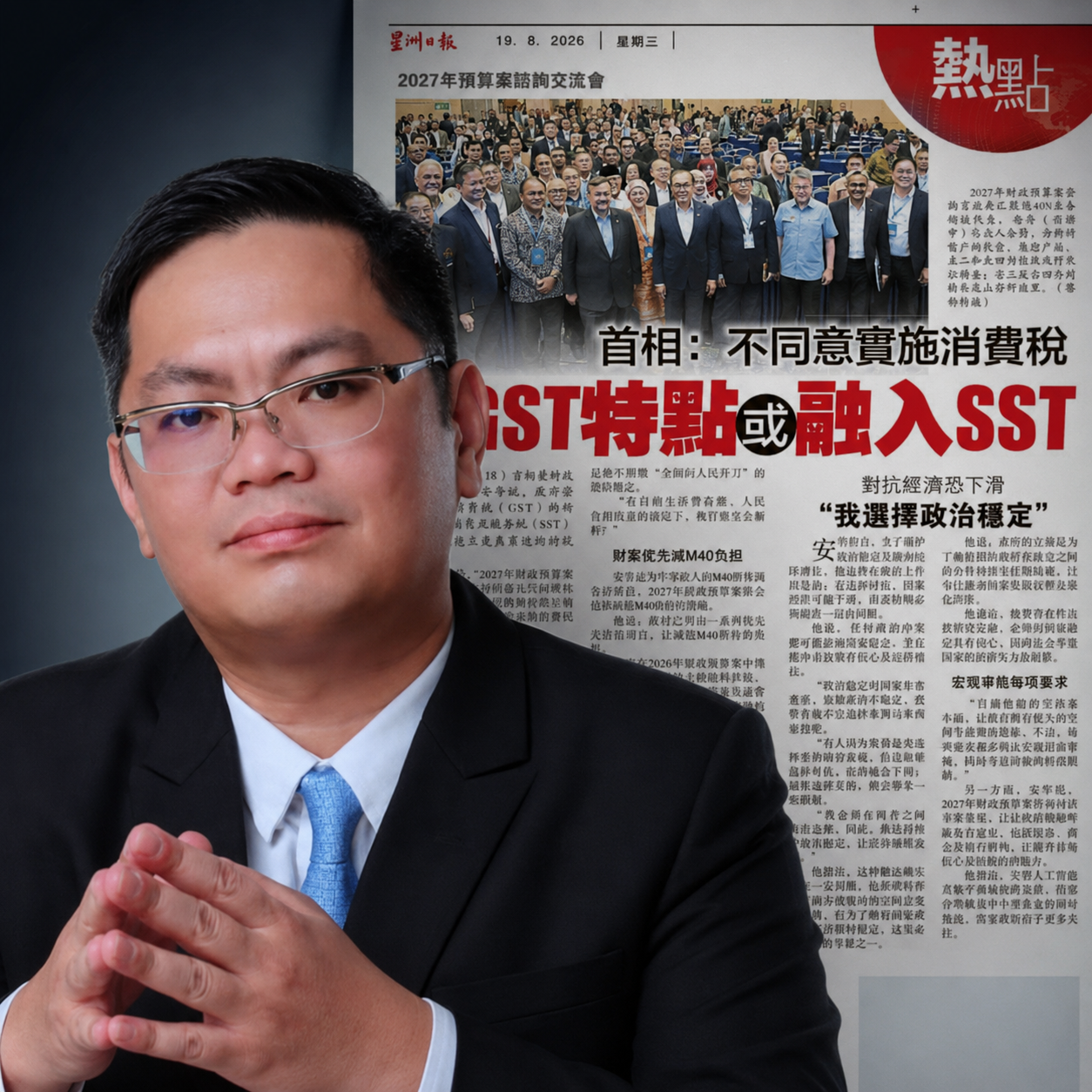
KUALA LUMPUR — BERSATU Puchong Division Associate Wing chief Dato’ Gan Yong Hwa said the government should heed the views of the business community and the public and reintroduce the Goods and Services Tax (GST) at a lower rate, subject to safeguards such as exempting essential goods, protecting lower- and middle-income groups and preventing businesses from taking advantage of the system to raise prices.
He said this would create a fairer, more transparent and more efficient taxation system.
Gan said many Chinese business organisations, chambers of commerce, industry associations and manufacturers have repeatedly stated that a well-designed GST offers a broader tax base and a more transparent input tax credit mechanism than the Sales and Service Tax (SST). It can also reduce the hidden costs caused by cascading taxes throughout the supply chain.
“The government should not reject the entire GST system simply because there were weaknesses in its previous implementation. What should be reviewed is whether the tax rate was too high, whether refunds were made promptly, whether essential goods were exempted and whether lower-income families received adequate protection.
“The government should not continue relying on an SST system that has more loopholes and an inconsistent scope of taxation.”
He was responding to Prime Minister and Finance Minister Datuk Seri Anwar Ibrahim’s statement that the government was prepared to study the possibility of incorporating certain GST elements into the SST to establish a more progressive tax system.
Gan said that since Anwar had acknowledged the advantages of some GST mechanisms, he should not reject a comprehensive review of the GST merely because of political baggage. Such an approach could ultimately produce a complicated hybrid tax system that retains the weaknesses of the SST while adding GST reporting requirements.
“GST and SST are two systems that operate according to different principles. If the government takes a little from one system and a little from the other, the outcome may not combine the strengths of both. Instead, businesses could be forced to bear the administrative costs of two different systems.”
He said Chinese business organisations such as the Associated Chinese Chambers of Commerce and Industry of Malaysia (ACCCIM) have repeatedly pointed out that the GST provides a more comprehensive, transparent and effective tax base.
The Federation of Malaysian Manufacturers (FMM) has also consistently highlighted the problem of tax cascading under the SST. Taxes paid by businesses when purchasing raw materials, components and services cannot be fully claimed as credits. These costs therefore accumulate throughout the supply chain before being passed on through product prices to consumers.
Gan said the GST’s input tax credit mechanism allows businesses to pay tax only on the value they add. This reduces multiple taxation and ensures that transactions are recorded at every stage of the supply chain.
Besides helping to curb tax evasion and the underground economy, the system can create a fairer competitive environment for law-abiding businesses.
“People may assume that the SST imposes a lighter burden because it is levied only at the production or import stage. However, part of the tax cost is already hidden in the price of goods.
“Under the GST, consumers can at least see clearly how much tax they are paying, while the government can more easily trace the flow of tax revenue.”
Gan said a stable and broad-based consumption tax system could also increase government revenue and provide long-term funding for public healthcare, education, public transport, affordable housing, community development and targeted assistance programmes.
He said the government announces various programmes for the people every year, but these initiatives cannot be sustained solely through borrowing, petroleum revenue or the ad hoc introduction of different taxes.
The country needs a stable source of revenue to ensure that assistance programmes are not repeatedly changed because of fiscal constraints.
“After collecting additional revenue, the government must channel it back to the people and publicly account for how GST revenue is used for healthcare, education, public transport and assistance for vulnerable groups.
“The public will only support the system when there is a clear connection between the taxes collected and the benefits delivered.”
Gan urged the government to establish a Tax Reform Committee comprising parties from both the government and opposition, the Ministry of Finance, Royal Malaysian Customs Department, Inland Revenue Board, Bank Negara Malaysia, consumer organisations, ACCCIM, industry chambers, and professional accounting and taxation bodies.
The committee should conduct a comprehensive comparison of the actual effects of the GST, SST and the proposed hybrid system on prices, business costs, government revenue and lower-income families.
He also proposed that before reintroducing the GST, the government should guarantee prompt input tax refunds to businesses, publish transparent reports on how tax revenue is used, establish a price-monitoring mechanism and take stern action against businesses that exploit the GST as an excuse for profiteering.