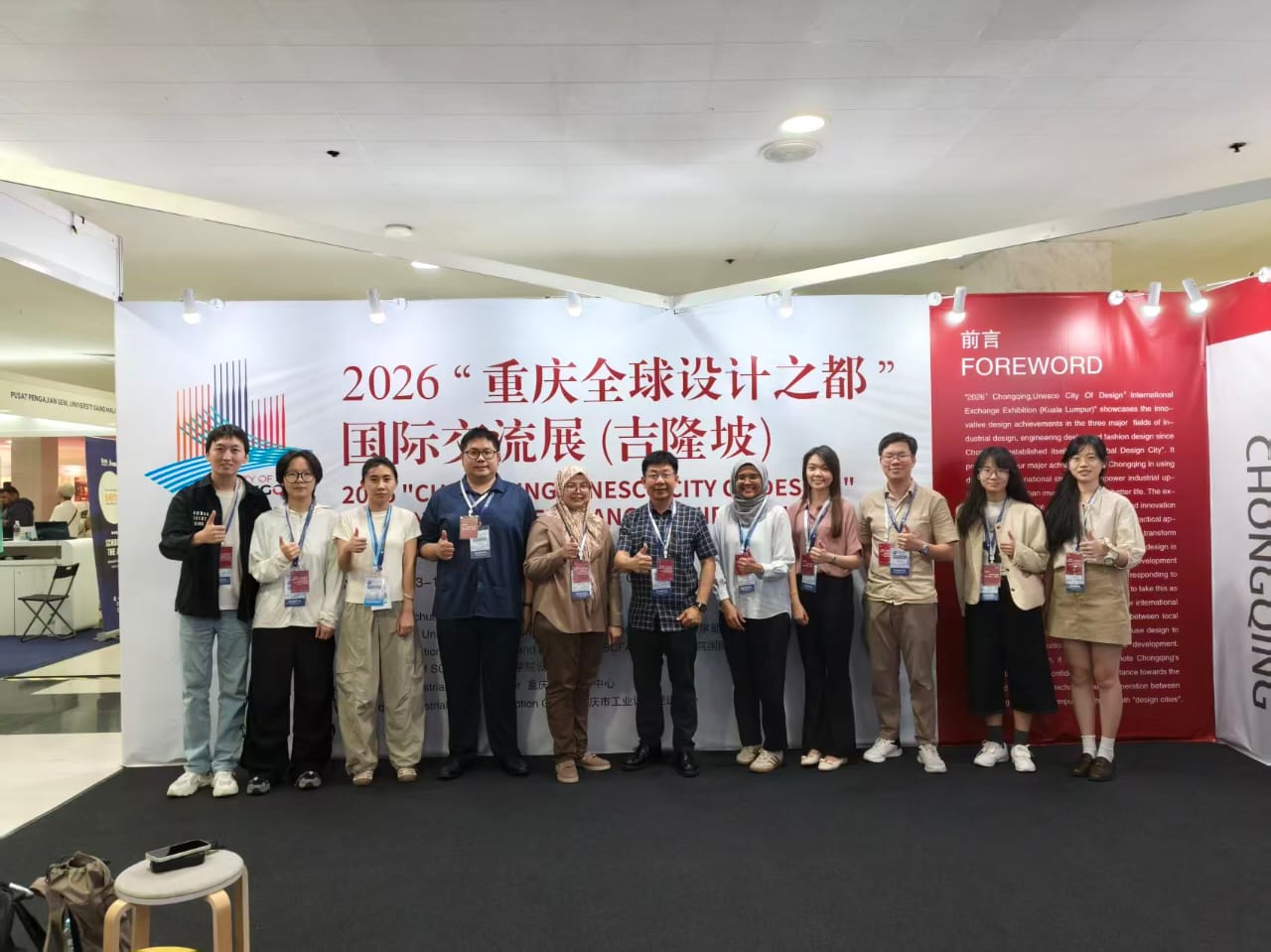
KUALA LUMPUR – From lunar spacesuits and smart vehicles to assistive devices designed for the elderly and visually impaired, more than 150 innovative design works from Chongqing, China, are being showcased in Kuala Lumpur, highlighting the immense potential of integrating art, technology and industrial manufacturing.
The 2026 “Chongqing UNESCO City of Design International Exchange Exhibition” (Kuala Lumpur), jointly organised by the Sichuan Fine Arts Institute (SCFAI) and the Centre for Energy Sciences at Universiti Malaya (UM), opened today at the World Trade Centre Kuala Lumpur in conjunction with the Kuala Lumpur Design Summit 2026 (KLDS 2026).
The exhibition showcases Chongqing’s achievements in industrial design, engineering technology, urban regeneration and people-centred innovation to an international audience.
The three-day summit, themed “Designers Driving Industry Forward”, brings together representatives from government agencies, businesses, higher education institutions and international design organisations to promote design-led innovation and industrial transformation.
The exhibition is coordinated by Professor Lü Xi, Dean of the School of Design at Sichuan Fine Arts Institute, with the collaboration of Professor Ir Dr Chong Wen Tong, Fellow of the Academy of Sciences Malaysia and Director of UM’s Centre for Energy Sciences, as well as Professor Wei Yong, Executive Director of the Chongqing Industrial Design Centre at Sichuan Fine Arts Institute.
Among the highlights are the “Xuntian” Lunar Spacesuit System Component Design, a gold award-winning work at the Fourth China Fine Arts Awards, a mobile lunar research station, automotive concept designs developed in collaboration with Honda, as well as intelligent equipment and emergency rescue devices.
These exhibits demonstrate the growing importance of innovative design in aerospace technology, advanced manufacturing and industrial product development.
The exhibition also places strong emphasis on social and everyday needs, featuring specially designed kitchen utensils for visually impaired individuals, companion wheelchairs for senior citizens and toilet-assistance lifting devices.
These innovations reflect how thoughtful design goes beyond aesthetics to improve quality of life, particularly for vulnerable and underserved communities.
Urban regeneration projects in Chongqing, including Hongyadong, Liziba and Minzhu Village, alongside the city’s spectacular drone performances along the banks of its two rivers, further demonstrate how design can integrate local culture, urban development and digital creativity.
Professor Chong said Malaysia and China possess complementary strengths in artistic design and engineering technology, providing considerable opportunities for deeper collaboration.
He noted that efforts would continue to strengthen partnerships between Universiti Malaya and Sichuan Fine Arts Institute, particularly in interdisciplinary research, talent development and the commercialisation of technological innovations.
He expressed hope that integrating advanced technology with artistic design would inject fresh momentum into the development of Chongqing and Kuala Lumpur as two UNESCO-designated Cities of Design.
Such collaboration, he added, could also facilitate the introduction of more cross-border innovations combining aesthetic value with commercial potential into Southeast Asian markets.
—
【Professor Chong Wen Tong: Bridging Engineering Innovation, Sustainable Energy and Creative Design】
【Advancing Malaysia–China Collaboration Through Interdisciplinary Research and Industry Partnerships】
Professor Dr Chong Wen Tong is a Fellow of the Academy of Sciences Malaysia, a Chartered Engineer registered in the United Kingdom, and currently serves as Professor in the Department of Mechanical Engineering and Director of the Centre for Energy Sciences at Universiti Malaya.
With decades of experience spanning academia and industry, Professor Chong has established a distinguished track record in scientific research, technological innovation and the practical application of engineering solutions.
He previously worked with internationally renowned companies, including Dyson and Sony, and has published more than 200 papers in international academic journals.
He has also been recognised among **Stanford University’s World’s Top 2% Scientists for seven consecutive years, from 2020 to 2026**, and has received more than 25 international invention awards.
Among his notable innovations is the patented **Cross-Axis Wind Turbine**, which won First Prize in the Patent Category at the 2016 Malaysian National Intellectual Property Awards (AHIN).
The technology has also progressed towards commercialisation through collaboration with PETRONAS, Malaysia’s national oil and gas company.
As an interdisciplinary expert whose work integrates industrial aerodynamics, green energy technologies and innovative product design, Professor Chong’s professional background closely aligns with the central theme of KLDS 2026, “Designers Driving Industry Forward.”
Drawing on his expertise in engineering science and industrial design, Professor Chong has actively promoted interdisciplinary collaboration between Malaysia and China, particularly in bridging artistic design and engineering disciplines.
His efforts have helped strengthen institutional partnerships between Universiti Malaya, Sichuan Fine Arts Institute and other leading universities, creating opportunities for deeper cooperation in research, education and industrial innovation.
By bringing together cutting-edge technologies and creative design, Professor Chong aims to contribute to the continued development of Chongqing and Kuala Lumpur as UNESCO Cities of Design.
He is also committed to facilitating the introduction and commercialisation of cross-border innovations that combine aesthetic excellence, technological sophistication and market potential, particularly within Southeast Asia’s rapidly evolving industrial and creative economies.